 Living and transport — Money in Thailand
Illustrated: Currency exchange and ATMs in Thailand. 4 ways to turn yen into baht and the fees charged
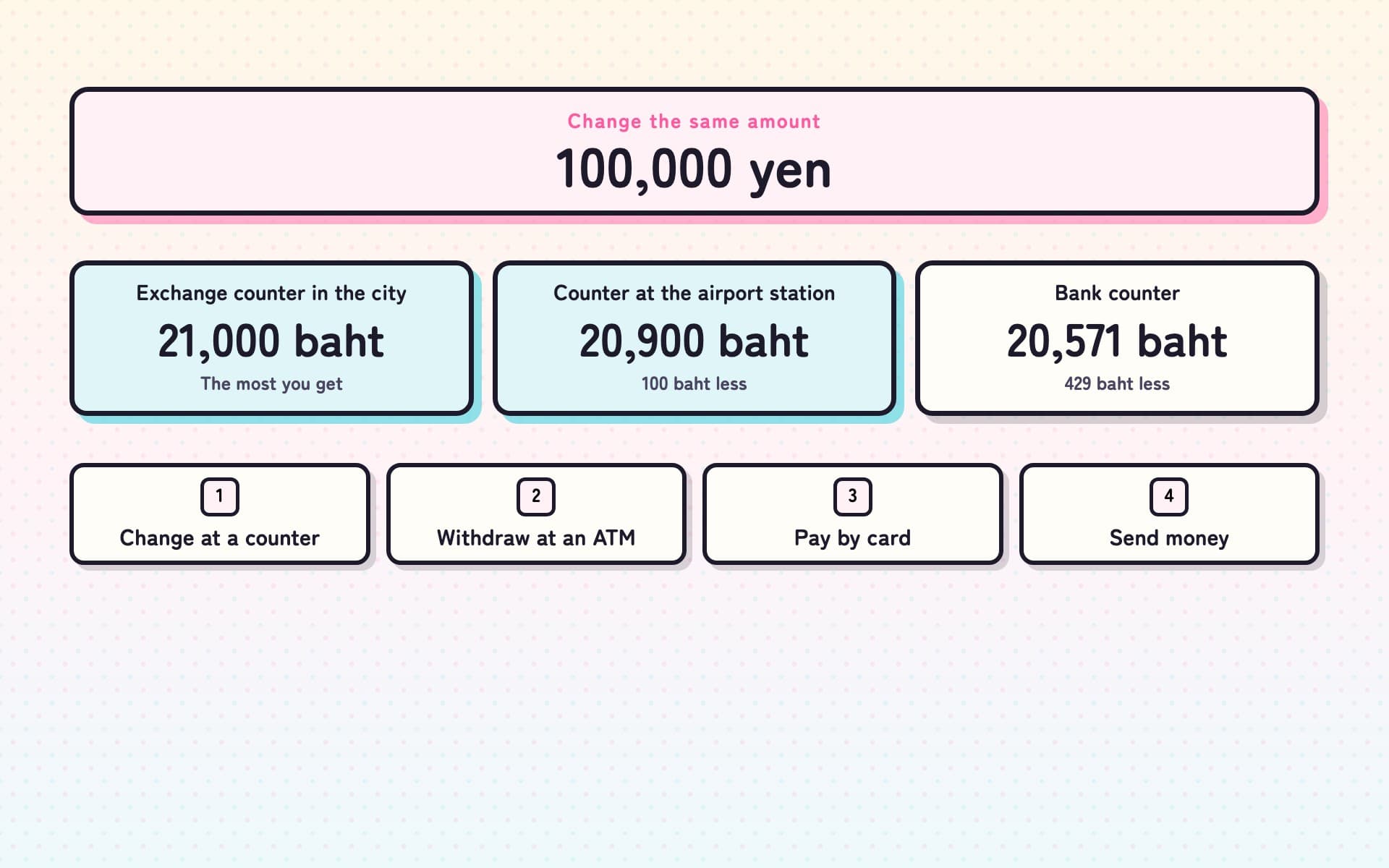
Arriving at the currency exchange counter, I look up at the posted rates. Is it a good deal to exchange money here? Or is it better to withdraw cash from an ATM? I compare 4 methods in Thailand: currency exchange, ATMs, card payments, and money transfers, looking at what is charged and how much 100,000 yen becomes if exchanged in cash.
4 Ways to Exchange Yen to Baht
There are 4 ways to turn yen in Japan into a usable form in Thailand. The amount received changes depending on whether exchanging at a booth, withdrawing from an ATM, paying by card, or sending a remittance.
The difference arises because what is charged varies by method. There is a portion included in the posted rate, a fee incurred for every withdrawal, and a markup added when making purchases, all with different names and charged in different places.
When I exchanged currency in another country, I exchanged 20,000 yen and got 25 small bills, making me wonder if there was a need to exchange for cash in the first place. In Thailand as well, that is the first thing to consider.
How much is lost from the mid-market rate by exchange location
The greater the decrease from the amount calculated at the mid-market rate, the longer the bar becomes.
01Calculated at the mid-market rate, 100,000 yen is 21,105 baht. The actual amount received is less than that, and how much it decreases from the mid-market rate varies depending on where it is exchanged.
The difference between money changers at the airport station and those in the city is small; the big gap is between money changers and banks.
Fees for Money Changers, ATMs, Cards, and Transfers
The names of the charges differ depending on the method. Listing what is charged by which method makes it clear which one is suitable for me.
What is charged by which method
The top shows the names of the charges, and the bottom shows the methods charging them.
02Exchange booths only charge the margin included in the posted rates, but ATMs and cards charge two fees each. In addition, for ATMs and cards, the difference between the rate used by international brands and the mid-market rate is also added.
Exchanging at Money Changers
At currency exchange booths, the amount calculated at the posted rate is received exactly as is. No other fees are charged. The original passport or ID is shown at the counter.
Withdrawing from ATMs
Inserting a card into an ATM to withdraw local currency is called overseas withdrawal, and doing this with a credit card becomes a cash advance (borrowing). There are 2 things charged at an ATM. These are the fee incurred every time cash is withdrawn, and the markup added when yen (my home currency) is selected on the screen.
| Credit card brand | Amount charged per withdrawal |
|---|---|
| VISA | 250 baht |
| Mastercard | 350 baht |
| UnionPay | 250 baht |
The limit for 1 withdrawal is decided by the bank of the ATM. The limit for 1 day is decided by the card company that issued the card.
I have also withdrawn money from an ATM in Thailand. After being charged the fee, I now plan ahead so I don't have to use an ATM after arriving in Thailand.
Paying with Credit and Debit Cards
When presenting a card at a store, the card company converts the amount to yen at a rate that includes administrative processing fees. Even with the same card, this fee is not added when withdrawing from an ATM. However, the difference between the rate used by the international brand and the mid-market rate applies separately to both shopping and ATMs.
When paying by card, stores sometimes add a markup. When I presented my card at a massage shop, 3% was added to the price.
I always pay with my Wise card. People living in Japan can also get one, and when paying in a currency with no balance, a currency with a balance is automatically converted to cover the payment.
Transferring Money via Wise and Others
Money sent via Wise only arrives in bank accounts within Thailand. Only those with a bank account in Thailand can receive it.
If giving to someone who does not have an account, there are money transfers that can be received as cash at an agent location. Overseas remittances from banks cannot be applied for without account information.
Thai bank accounts cannot be opened depending on the type of stay. Kasikornbank officially states that people entering on a tourist visa or without a visa cannot open an account.
Differences Between Mid-Market Rates and Money Changer or Bank Rates
Calculated at the mid-market exchange rate, 100,000 yen is 21,105 baht. From here, the amounts lost depending on the exchange location are listed.
| Exchanging location | How many baht 100,000 yen becomes | Difference from the mid-market rate |
|---|---|---|
| Amount calculated at the mid-market rate | 21,105 baht | — |
| Money changer in the city | 21,000 baht | 105 baht less |
| Money changer at the station in Suvarnabhumi Airport | 20,900 baht | 205 baht less |
| Bangkok Bank counter | 20,590 baht | 515 baht less |
| Kasikornbank counter | 20,571 baht | 534 baht less |
The difference between the currency exchange at the airport station and the one in the city is 100 baht, and the difference between the city exchange and a bank is over 400 baht. The amount received changes significantly depending on whether the money is exchanged at a currency exchange or a bank. The bank booths in the terminal do not publish their rates.
For ATMs as well, the fees for the same 100,000 yen amount are calculated. Withdrawing 100,000 yen worth of baht requires splitting it into 2 transactions at banks with a 20,000 baht limit per transaction, and the fee with a VISA card is 500 baht.
Choosing by Situation
Even for the same person, the suitable method changes right after arriving compared to during the stay. The choice is made based on how much is on hand and what will be paid for next.
| Situation | Suitable method | What to check first |
|---|---|---|
| Right after arriving, with no baht on hand | Exchange at a money changer | The posted rate and whether a passport is on hand |
| Running out of cash in the city | Withdraw from an ATM | The fee per transaction and not selecting yen |
| Expensive purchases or paying for accommodation | Pay with a credit card | Asking at the register if the store adds a surcharge |
| Giving money to someone with a bank account in Thailand | Send money | Whether the receiving bank is included in the destination list |
For those who prefer not to wander around the city looking for an exchange counter right after arriving, there is an option to exchange just enough for immediate needs at the exchange counter at the airport station, and exchange the rest in the city.
Cash You Can Bring Into Thailand and Baht You Can Take Out
When leaving and entering Japan, a declaration is required depending on the amount of cash brought in or taken out. When leaving Thailand, there is a limit on the amount of baht that can be taken out.
The amount from which a declaration is required when entering Thailand was not listed on the Thai Customs page. The guide for travelers, the FAQ, and the list of forms were checked, but no line with the amount written could be found.
Shops That Do Not Accept Cards
Arriving with the intention of paying by credit card causes trouble when unable to pay at stores that do not accept cards. Food stalls and local eateries are often cash-only, unlike stores in malls where cards are easily accepted.
There are also stores that do not accept cash. At such stores, payment can only be made using methods accepted by the store, such as credit cards or QR code payments.
Therefore, both cash and a credit card are carried when going out. Having only one or the other leads to encountering a store where payment cannot be made.
If the baht on hand is all 1000 baht bills, they cannot be used at street stalls. Where they can be broken down is in the article below.
[Illustrated] How to break a 1,000-baht note in Thailand: turning the notes street stalls refuse into 100-baht notesWhen leaving a currency exchange, the wallet usually has 1000 baht notes in it. But at food stalls and local eateries, handing over that 1 note is often rejected, leaving me stuck. There are 3 ways to break a 1000 baht note in Thailand: at a station ticket window, at 7-Eleven, and at a large store's register. Tourists without a bank account can also set up QR code payments with a passport.amiresort.com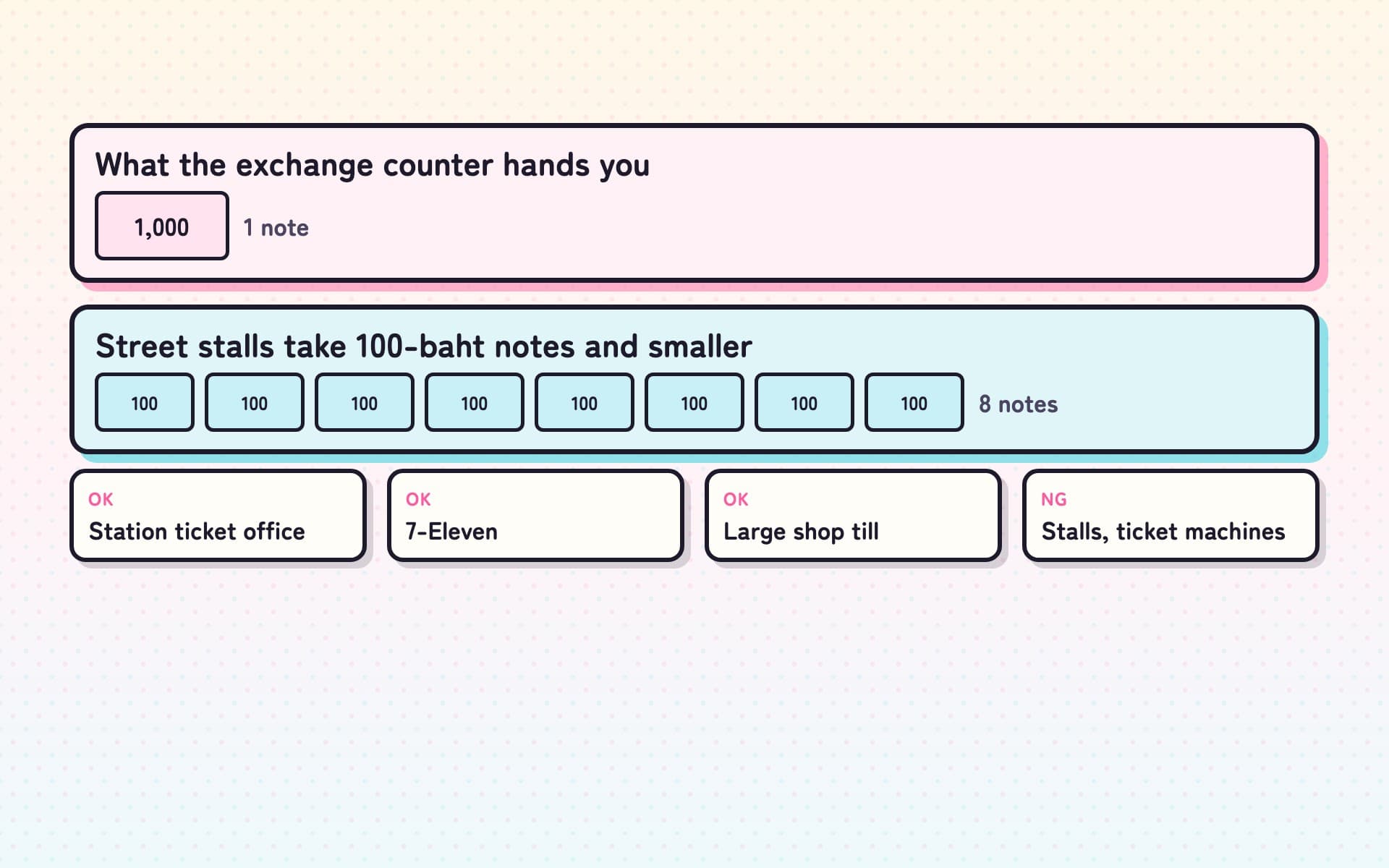
Common Misconceptions
- ❌ The recipient can receive cash with any money transfer. In reality, the receiving method changes depending on the type of transfer. For a recipient without a bank account, a transfer that can be picked up at an agent location is selected.
- ❌ Exchanging money at the airport station means losing a large percentage. In reality, at the same time, the difference was 100 baht for 100,000 yen compared to a currency exchange in the city. The difference between a currency exchange and a bank is larger. Since the bank booths in the terminal do not publish their rates, they cannot be compared.
- ❌ Money can be sent from the post office counter. International remittances at the counter and through Yucho Direct ended at the end of August 2025.
- ❌ The ATM fee is 220 baht. I checked all the official fee schedules of four Thai banks, but the amount of 220 baht was nowhere to be found. The published fees are 250 baht for VISA and 350 baht for Mastercard.
- ❌ Old 10,000-yen notes can definitely be exchanged at money changers in the city. No money changers or banks were found that publish whether they can be exchanged, and the only option is to ask at the counter.
Summary | What to decide before exchanging
Currency exchanges usually give out 1000 baht bills. Breaking them down for use at food stalls completes the preparation for paying in Thailand.
| Method | What is charged | What to decide in advance |
|---|---|---|
| Exchange at a money changer | Margin built into the posted rate | Whether to exchange money in the city or at the airport station |
| Withdraw from an ATM | Fee per withdrawal and the markup added depending on the screen selection | How much to withdraw at one time |
| Pay with a credit card | Administrative processing fees and the markup added by the store | Asking at the register if there is a surcharge before paying |
| Send money | Sending fee and the margin built into the exchange rate | Whether the recipient has a bank account |
The rates in this article were checked on the morning of September 22, 2026 (Thailand time). Rates change many times a day. The fees were verified using the official fee schedules of the respective companies and banks.