 Living & Moving — Thai visas
Explained: Thailand's visa-free stay is now 30 days. What changed from 60 days, and which visas cover the rest
Flights booked first, the days of the stay recounted afterwards — a familiar order. Thailand's visa exemption changed from 60 days to 30 days on 15 September 2026, and many of the articles now in circulation still carry the number from before the change. How many days entry without a visa allows, and which visa comes into it beyond that, laid out in order from the shortest length of stay.
Thailand's visa exemption dropped to 30 days on 15 September 2026
At immigration, a date is stamped into the passport. What it records is not how many days are allowed but the date by which you must leave. That date is the one to work a trip around.
So how many days does that stamp cover? For a Japanese passport holder arriving as a tourist, the length of stay without a visa runs to 30 days. Until 14 September 2026 it was 60 days.
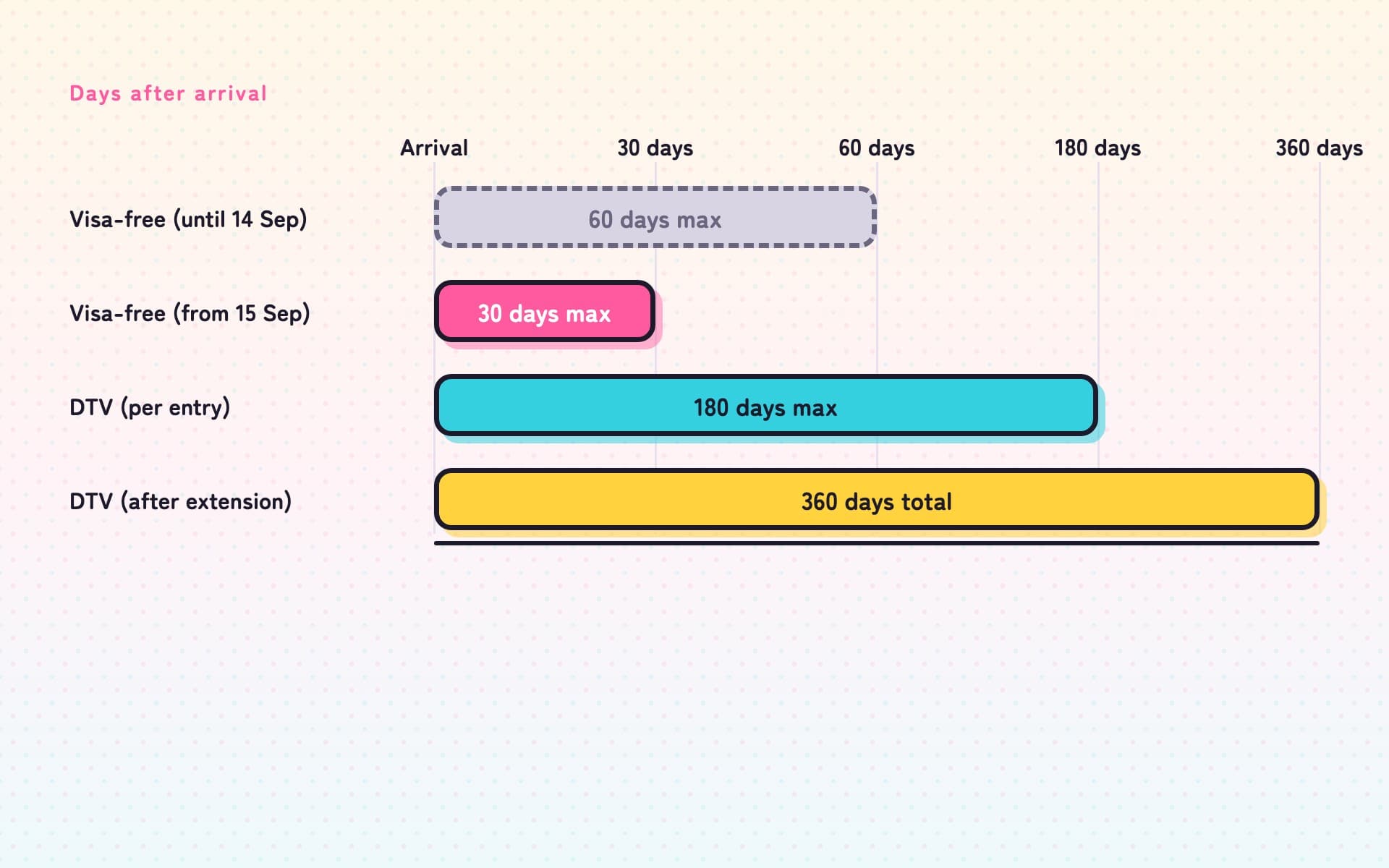
The days allowed without a visa shrank from 60 days to 30 days
The scale across the bottom counts days from entry. The 4 bars show which day the stay runs to in each case.
- Visa exemption (to 14 September)Day of entry 〜 60 daysUp to 60 days
- Visa exemption (from 15 September)Day of entry 〜 30 daysUp to 30 days
- DTV (one entry)Day of entry 〜 180 daysUp to 180 days
- DTV (after extension)Day of entry 〜 360 daysExit at 360 days in total
01The number of days allowed without a visa was halved on 15 September 2026. A stay longer than that calls for a visa. The bottom 2 bars are the days a visa allows.
Whether a visa is needed turns on the days of the stay, arrival by air or at a land border, and how many times Thailand has been entered this year
Whether a visa is needed is decided by how many days the stay runs. On top of that, it changes with whether the entry is made at an airport or across a land border, and with how many entries have already been made this year.
How many days a stay without a visa allows is set by the country of the passport. Arriving by air or across a land border, a Japanese passport gets the same 30 days. Only when the entry is made at a land border, entry without a visa is held to at most 2 entries in 1 year (January to December).
| No visa needed | A visa is needed | |
|---|---|---|
| Arriving by air | 30 days or less | More than 30 days |
| Arriving at a land border | 30 days or less, and no more than 2 entries this year | More than 30 days, or the 3rd entry this year |
Past 30 days, the visa splits by what the trip is for
When 30 days is not enough, a visa comes into it. Thai visas are split by purpose into 5: tourism, a long stay, study, retirement, and work.
1Going as a tourist — at 30 days or under, there is no visa to take
For tourism within 30 days, there is no visa procedure. It is a stamp at airport immigration and nothing more. Proof of funds is sometimes asked for at entry, though.
For an itinerary that runs a little past 30 days, there is also the tourist visa. That one allows up to 60 days, and the application asks for proof of funds of 20,000 baht or more.
2Staying longer — 180 days per entry on a DTV, 360 days with an extension
For a stay measured in months there is the DTV (Destination Thailand Visa), a visa sometimes called a nomad visa. The visa itself is valid for 5 years with entries and exits as often as wanted, and 1 entry allows a length of stay of 180 days.
3 groups qualify for the DTV: people working remotely, people learning Muay Thai or Thai cooking or going for medical treatment, and the family of a DTV holder. Which group applies decides which documents go in.
| Category | Who it covers |
|---|---|
| Workation | Digital nomads, remote workers, freelancers and the like |
| Activities tied to Thai soft power | Muay Thai, Thai cooking courses, medical treatment and the like |
| Family | The spouse of a DTV holder, and children under 20 |
The part to watch is the supporting documents. They changed on 31 August 2026. People who finished the application and the payment before that date go through on the old documents, so the documents that appear in an account by someone who got the visa a little earlier differ from what is asked for now.
The DTV document requirements changed on 31 August 2026
The top row is how it was, the bottom row is how it is now. For item 1, a My Number card or an air ticket used to be enough; now it has to be a copy of the My Number card. Item 2 is newly added.
02For a person without Japanese nationality, the proof of permanent residence is a copy of a residence card marked "Permanent Resident". For a child under 14, the criminal record clearance certificate filed is not the child's own but that of the DTV holder.
3Study, retirement and work — visas for a purpose that is already settled
The rest are for people whose purpose is already settled. Study is a student visa (ED), a stay after retirement at 50 or over is a retirement visa (O), and working for a Thai company is a work visa (B).
For work there is a work permit procedure separate from the visa. Work inside Thailand starts once that permit has been granted. And the remote work that the DTV workation category has in mind is work for a company outside Thailand, not a Thai company.
| Visa | Stay per entry | Main conditions | Where to file |
|---|---|---|---|
| Visa exemption | Up to 30 days | Tourism. Land border arrivals: 2 per year | Nothing to file |
| Tourist visa (TR) | Up to 60 days | Proof of funds of 20,000 baht or more | e-Visa |
| DTV | 180 days (360 days with an extension) | A balance of 500,000 baht or more. Proof of permanent residence in Japan and a criminal record clearance certificate | e-Visa |
The table carries the 3 for which the number of days allowed is published officially. The student, retirement and work visas are not in the table, because how many days an entry allows is not published for them.
Even without a visa, a registration before entry applies
Visas were the subject up to here. Separately from whether a visa is needed, the TDAC (the arrival card) registration applies to everyone. It is filed online before arrival.
It opens 3 days (72 hours) before arrival in Thailand. Opening it earlier than that returns an error instead of a registration. With every other preparation finished ahead of time, this one alone waits until 3 days before arrival.
On a connecting flight, the registration applies if Thai immigration is cleared. Changing planes without going through immigration does not take it. The authorities have also issued a warning that fake sites imitating the registration site are in circulation.
Once the registration is actually under way, the address fields are where many people stop. The address of the place of stay is split into District and Sub-district fields, and which part of a hotel address goes where is hard to tell. How those fields are filled in is covered in a separate article.
Illustrated Guide: How to Read and Write a Thai Address, for Arrival Cards, Hotel Bookings, and International MailEver stalled at a Thai address field? On an arrival card, a hotel booking, an online shopping delivery form, or the front of an international parcel, the snag is the same. Using a Bangkok address written in the Latin alphabet as the example, the diagrams below split it into 7 parts and show what each part means, which box on a form it goes in, and what order it takes on an envelope. They also explain what a soi is.amiresort.com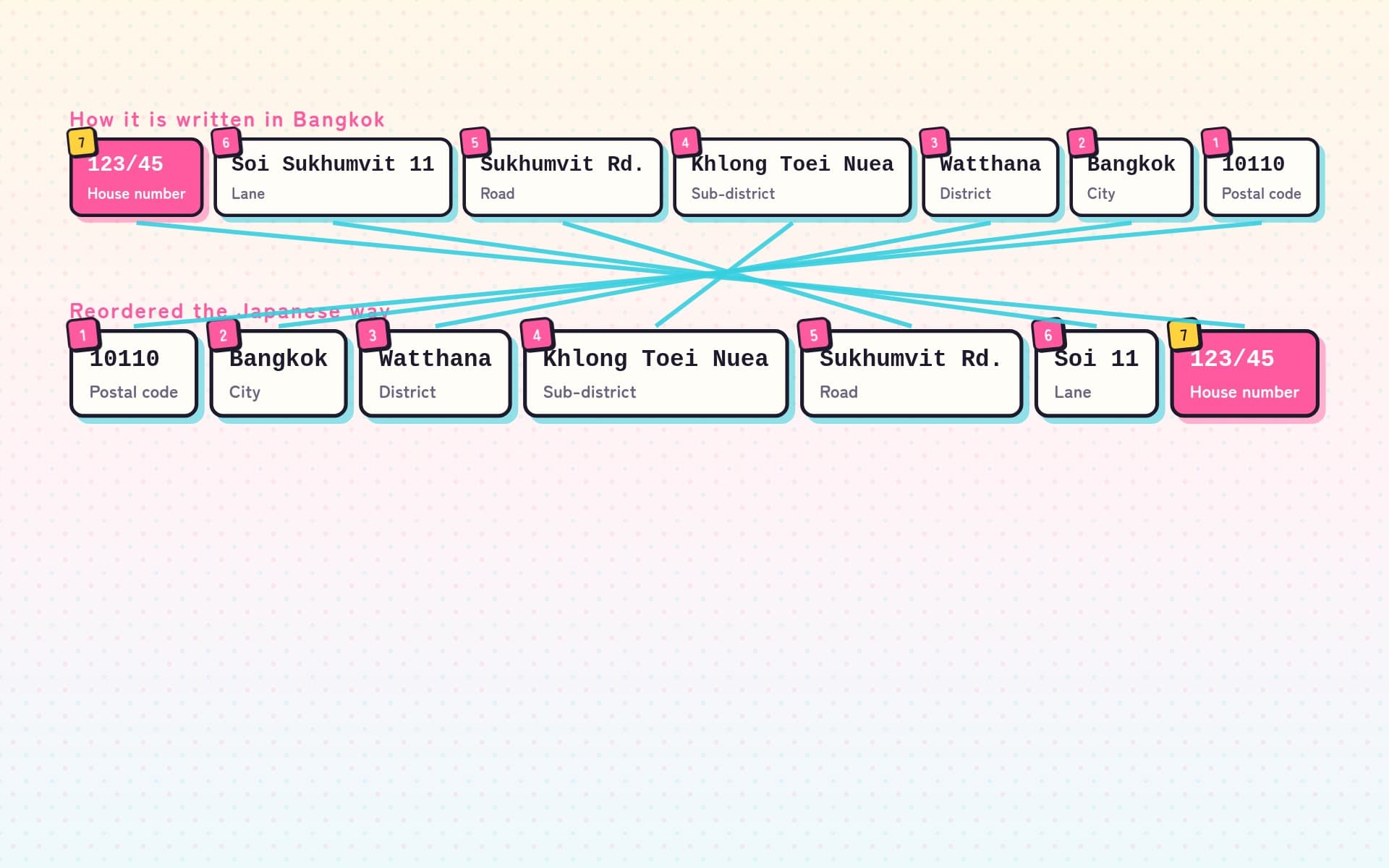
Common misconceptions
- ❌ The documents for a DTV are whatever list turns up online → They changed on 31 August 2026. A My Number card or an air ticket used to be enough; now it has to be a copy of the My Number card, and a criminal record clearance certificate from the police has been added. Accounts from people who applied before the change describe the old documents.
- ❌ Entering across a land border or by sea allows only 15 days → That rule no longer exists. The 15 days applies to holders of Seychelles and Mauritius passports; a Japanese passport gets 30 days whether the entry is by air or across a land border. The rule of at most 2 entries in 1 year applies only to entries at a land border.
- ❌ Immigration will stop you without 20,000 baht in cash → Under the visa exemption it is 10,000 baht per person (20,000 baht is the figure for a family, or for one person on a tourist visa). Forms other than cash are accepted. It is not a new rule either, but one that has been in place since 1980.
- ❌ With no visa needed, there is nothing to do before departure → Separately from whether a visa is needed, the TDAC registration applies to everyone. It has run since 1 May 2025, across a land border, by sea and by air.
- ❌ Passing through a Thai airport on a transfer also takes a TDAC → A transfer that clears immigration does. A transfer without entry does not.
The order of things before departure
The run-up to departure goes in this order. The days get counted first. Counting from the date of entry, the question is whether the date on the return ticket falls within 30 days.
If it fits, no visa is needed. If it runs over, the visa is applied for before departure. Either way, the TDAC registration is the last step left.
Before departure: the days, the visa, the proof of funds, the TDAC
Checked in order from the top.
03The days, the visa and the proof of funds can all be settled in advance. Only the TDAC cannot be filed until 3 days before arrival. That is the one that gets forgotten.
The rules are still in motion. For anyone whose departure is still some days off, opening the official notices once more just before leaving is the surer course.
The rules described in this article were checked on 21 September 2026.