 Life and Transit - Thai e-Visa
Illustrated: How to apply for a Thai e-Visa. Criminal record certificate added only for DTV, tourist visa remains unchanged
When opening the application screen, all the field names are listed in English. What goes into which field? The official manual is only an English PDF, and there are no examples of how to fill it out in Japanese anywhere. I will look at the Thai e-Visa application method in Japanese, field by field in the order of the screens, and line up the required documents for the DTV, which changed on August 31, 2026, alongside the ones from before the change.
How to apply for a Thai e-Visa and the flow until receiving the visa
First, I create an account and log in, fill out the application form, and upload the documents. After that, I pay the fee and wait for the review, and the approval document arrives by email. This order does not change no matter which visa I get.
| Numbers to know before applying | |
|---|---|
| Application fee (tourist visa, single entry) | 5,500 yen |
| Application fee (DTV = for long-term stay, 5-year multiple entry) | 52,000 yen |
| Payment methods | Visa or Mastercard credit card |
| Processing time | Within 15 working days (excluding weekends and embassy holidays) |
| When to apply | From 3 months before the planned date of entry |
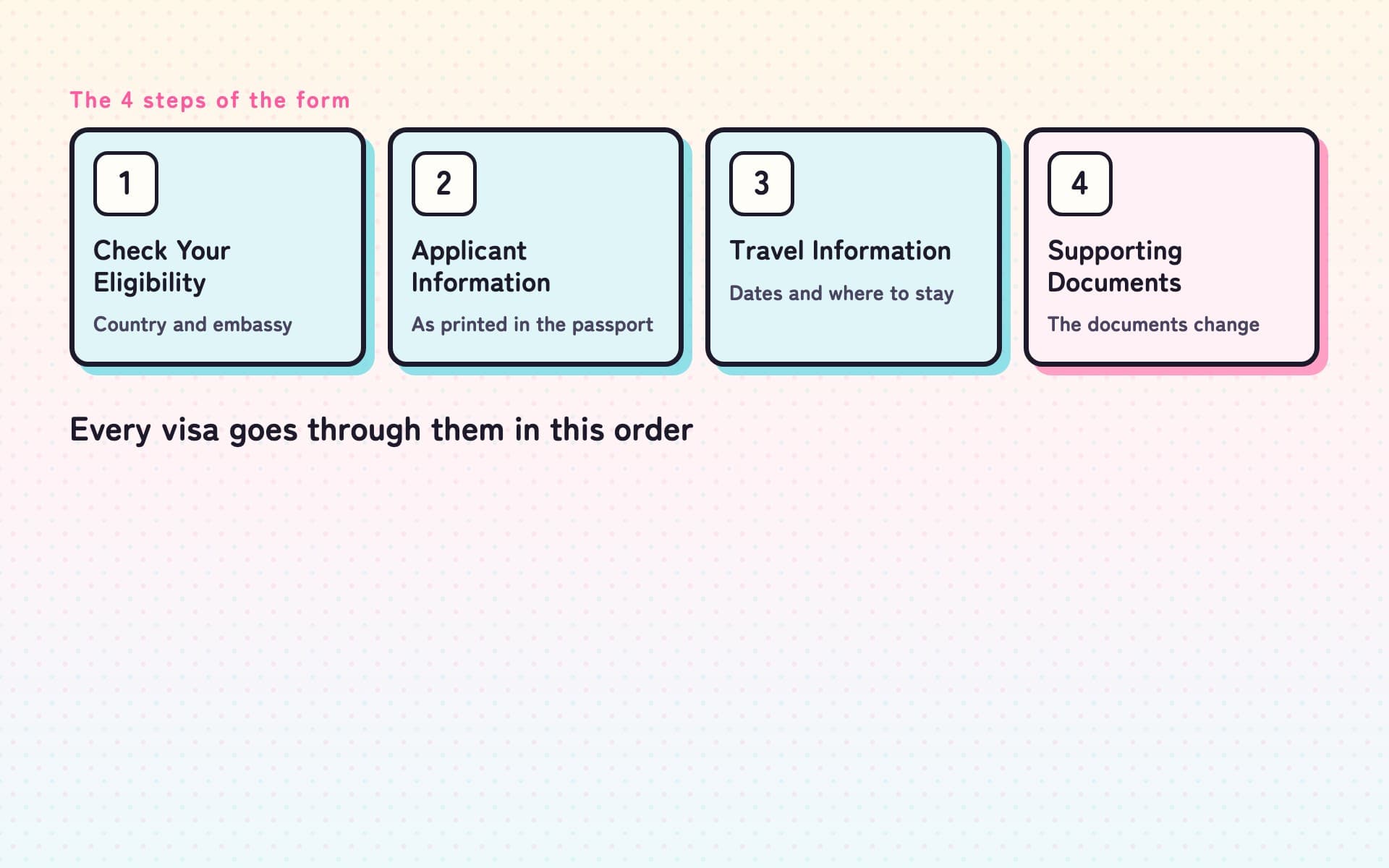
Of the 6 steps in the diagram, "Fill in an application form" is divided into 4 further stages. The table below shows the contents.
| Step | Heading on the screen | What to enter |
|---|---|---|
| 1 | Check Your Eligibility | The diplomatic mission to apply to and the visa to get |
| 2 | Applicant Information | Name, date of birth, passport, address, and occupation |
| 3 | Travel Information | Dates of arrival and departure, flight number, arrival airport, and accommodation |
| 4 | Supporting Documents | Passport, ID photo, proof of residence (varies by visa type), and financial documents |
Diplomatic missions to apply to and their coverage
On the first screen, the current location and which diplomatic mission (embassy or consulate-general) to submit to are entered. The destination is selected manually, but the correct choice is determined by the prefecture of residence. Those in countries other than Japan choose the mission responsible for their current location.
People in Japan have 3 options: Tokyo, Osaka, and Fukuoka, and select the mission from the table below. The screen is the same for all missions, but the required documents may differ depending on the mission.
| Where to apply | Areas covered by the mission |
|---|---|
| Royal Thai Embassy in Tokyo | Tokyo, Chiba, Gunma, Ibaraki, Kanagawa, Saitama, Tochigi, Aichi, Fukui, Gifu, Ishikawa, Nagano, Niigata, Shizuoka, Toyama, Yamanashi, Akita, Aomori, Fukushima, Iwate, Miyagi, Yamagata, Hokkaido |
| Royal Thai Consulate-General in Osaka | Nara, Wakayama, Kyoto, Osaka, Hyogo, Shiga, Mie, Tokushima, Ehime, Kagawa, Kochi |
| Royal Thai Consulate-General in Fukuoka | Fukuoka, Saga, Nagasaki, Kumamoto, Oita, Kagoshima, Hiroshima, Okayama, Shimane, Tottori, Yamaguchi, Miyazaki, Okinawa |
The required documents are checked by opening and comparing both the e-Visa page of the Thai Ministry of Foreign Affairs and the page of the mission where the application is submitted. The Ministry of Foreign Affairs page lists numbered items, and the mission's page provides a table detailing exactly which documents to submit for each number. There is also a single-page PDF summarizing the documents issued by the Royal Thai Embassy in Tokyo, but the version is old, and the current documents cannot be confirmed with it.
Even for the same item, the names of the required documents can differ depending on the embassy or consulate. For the DTV's "document indicating current residence in Japan", Tokyo lists a "copy of My Number Card," Fukuoka lists a "copy of certificate of residence," and Osaka lists a "certificate of residence or family register." Although the names vary, they all serve as documents proving "current residence in Japan," and the document to submit is the one listed by the specific office handling the application.
What is scarier than the differences between consulates is the difference in versions. Every consulate requires a criminal record certificate for the DTV, but the Japanese page for Fukuoka does not list that item. That is because it is stuck on the August 2025 version, one year before the DTV documents changed.
Entering the application form
The main body of the Thailand e-Visa application method consists of these 4 sections. None of the sections allow proceeding to the next without being filled out.
1Check Your Eligibility
The choices are the country that issued the passport, the current country, the embassy to submit to, the passport type, the purpose of visit, the visa type, and the number of entries. If it is determined here that an application cannot be submitted, proceeding further is not possible.
Depending on the visa type selected, extra fields are added to the next Applicant Information section. A school field appears for those going to study, and an employer field appears for those going to work. The number of sections and their order remain unchanged.
2Applicant Information
The fields for name, date of birth, nationality, passport number and expiration date, address, and occupation are filled in. The name and passport number are entered exactly as printed on the passport. However, alternative names written in parentheses are not included.
The remaining validity of the passport is also examined. A single-entry visa requires 6 months from the date of application, and a multiple-entry visa requires 1 year.
3Travel Information
The dates of entry and exit, the flight number, the arrival airport, and the accommodation are filled in. The arrival airport is a mandatory field, and selecting it makes the flight number field mandatory as well. Flight tickets are obtained before entering this section.
An application cannot be submitted more than 3 months before the intended date of arrival. The official guide suggests applying about 1 month before travel.
4Supporting Documents
In the final section, a series of numbered boxes appears. For a DTV, the required item for each box is specified, such as the photo page of a passport, an ID photo, proof of current residence in Japan, and financial documents. The number of boxes and the required documents vary depending on the visa type.
Documents are uploaded separately into each slot
The slots that line up for DTV and what goes into them
01The number of fields and the documents to submit vary by visa type. A tourist visa does not require a criminal record certificate, and the only document required for residence is a document indicating current location.
JPG, JPEG, and PDF can be uploaded, up to 3MB each. Only the face photo and the passport page do not accept PDFs.
Before the DTV document requirements changed, only 1 item was required regarding residence: a "document indicating current location." I submitted mine around that time, but the photo rules remain the same today. The photo I had on hand didn't meet the requirements, so I had it retaken at a photo studio.
DTV required documents, which changed on August 31, 2026
The documents to submit are fixed for each visa type. Among them, the documents for DTV changed on August 31, 2026.
02Before the change, submitting 1 item, "a document showing the current place of stay," was enough for the residence section. Now, the residence category has become "a document showing current residence in Japan," changing what to submit, and 1 police criminal record certificate has been added to another category. Passports, photos, money, and proof of activities remain the same as before.
Only the DTV changed, and documents for tourist visas and others remain the same as before. How to choose which visa to get is summarized in another article.
Explained: Thailand's visa-free stay is now 30 days. What changed from 60 days, and which visas cover the restFlights booked first, the days of the stay recounted afterwards — a familiar order. Thailand's visa exemption changed from 60 days to 30 days on 15 September 2026, and many of the articles now in circulation still carry the number from before the change. How many days entry without a visa allows, and which visa comes into it beyond that, laid out in order from the shortest length of stay.amiresort.com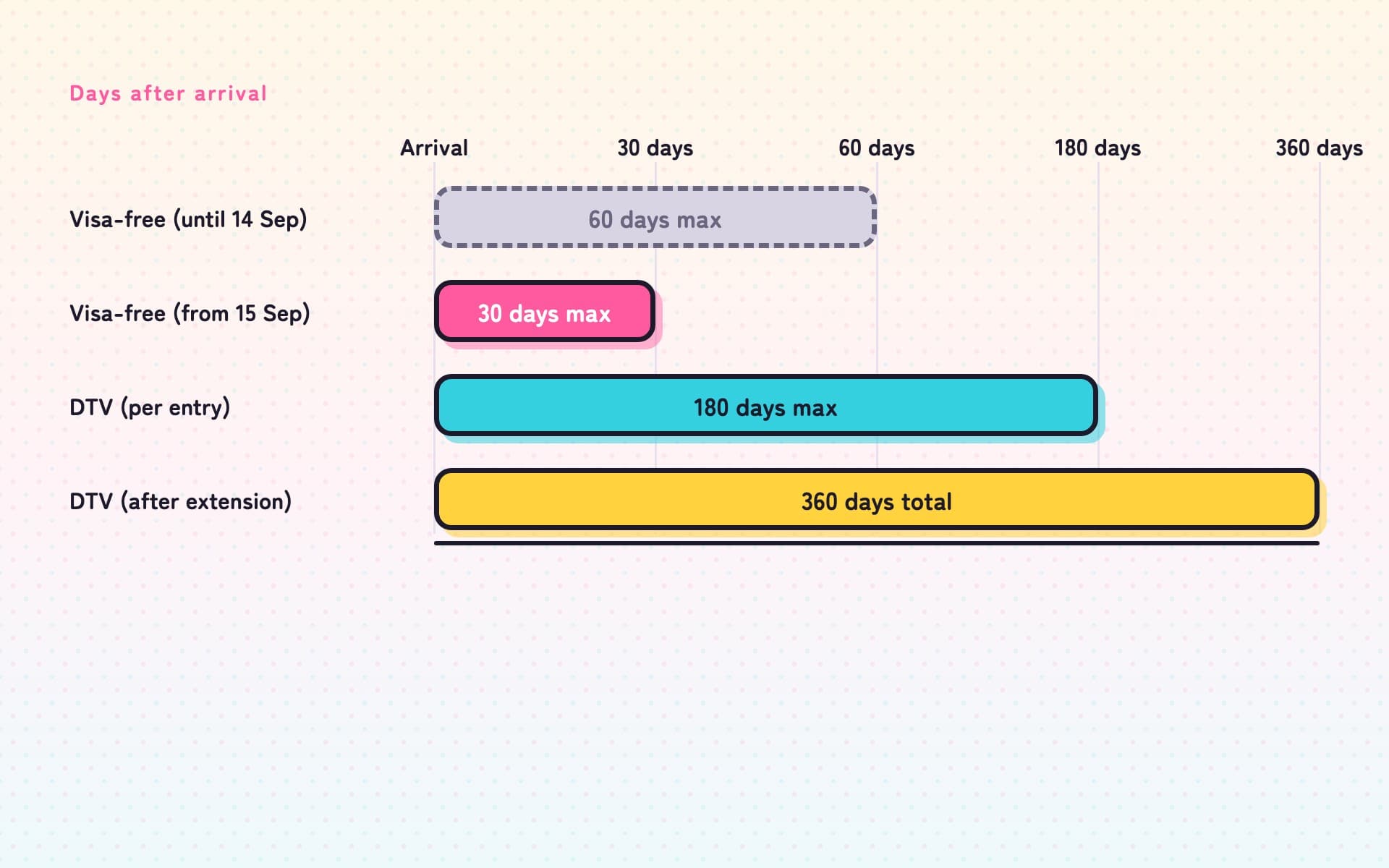
When I applied, a criminal record certificate was not required. The required documents changed 46 days after the date I submitted my application.
Application fee and accepted payment methods
The application fee is determined by the visa type. A single-entry tourist visa is 5,500 yen, and a DTV for longer stays is 52,000 yen.
Only Visa or Mastercard credit cards are accepted for payment. There are no other methods.
The paid fee will not be refunded. Even if a multiple-entry visa was applied for but a single-entry visa was issued, the difference will not be refunded.
Review period and interview
The Japanese guidance in Tokyo states that the three missions in Japan do not accept in-person applications. However, the same guidance also states that they reserve the right to call applicants for an interview.
On the 13th day after submitting it, I received an email specifying the date and time for an interview. The interview takes place at the diplomatic mission designated for the prefecture where I live. The approval email arrived 27 days after the day I submitted it.
The official guidance states within 15 working days, excluding weekends and embassy holidays. I waited 27 calendar days, which exceeded 15 working days even excluding weekends.
Common misconceptions
- ❌ Applying in person at the embassy → The three missions in Japan have not accepted in-person applications since January 1, 2025. The official site states, "Even if you come to the embassy to apply, you will not be admitted."
- ❌ Modifying after submission → Submitted details and documents cannot be modified until the review is complete. If the application is canceled and resubmitted, the fee will be charged again.
- ❌ Including the alias in parentheses exactly as on the passport → The part in parentheses is not included. Including it will result in the application being canceled.
- ❌ Being told the reason if rejected → The official site states that reasons for rejection cannot be answered even upon inquiry.
- ❌ A passport with 6 months remaining is enough → A multiple-entry visa requires 1 year.
- ❌ The earlier submitted, the safer → Applications cannot be submitted more than 3 months before the scheduled date of entry.
Checks before submission and the received documents
Things to check before submitting are the name, passport number, entry and exit dates, and the files placed in the slots. They cannot be modified after confirmation.
| Fields to check before submitting | What happens if they do not match |
|---|---|
| Name and passport number | Canceled and requires resubmission |
| Alias written in parentheses | Canceled if included |
| Total number of days staying | Cannot proceed if it does not match the trip length |
| File size and format | Files over 3MB or face photos in PDF format are not accepted |
When the screening is passed, an approval document arrives as a PDF. I print this out and show it to the airline and at immigration upon arriving in Thailand. It is the same in Bangkok and other airports.
The names of the fields on the screen and the rules for the documents to submit change without notice. Opening the page of the mission applied to once more on the day of submission before confirming prevents the need to cancel and resubmit.
The system information in this article was confirmed on September 21, 2026.