 Daily life and transit — Cash in Thailand
[Illustrated] How to break a 1,000-baht note in Thailand: turning the notes street stalls refuse into 100-baht notes
Leaving an exchange counter, what sits in the wallet is mostly 1,000-baht notes. At street stalls and local eateries, though, that note gets handed over and handed straight back, and that is where the trouble starts. A 1,000-baht note breaks in 3 ways in Thailand: a station ticket office, a 7-Eleven, and the till of a large shop. QR payment is open to visitors too, and registering for it takes a passport alone.
Breaking a 1,000-baht note in Thailand comes down to the destination
Out of the exchange counter, the wallet holds little but 1,000-baht notes. Held out at a street stall, that note gets a shake of the head.
Exchanging the money is not the end of it: what comes out of the counter does not work at a street stall. A 1,000-baht note travels only to a destination where it can be broken.
The notes from the exchange counter are not the notes a street stall takes
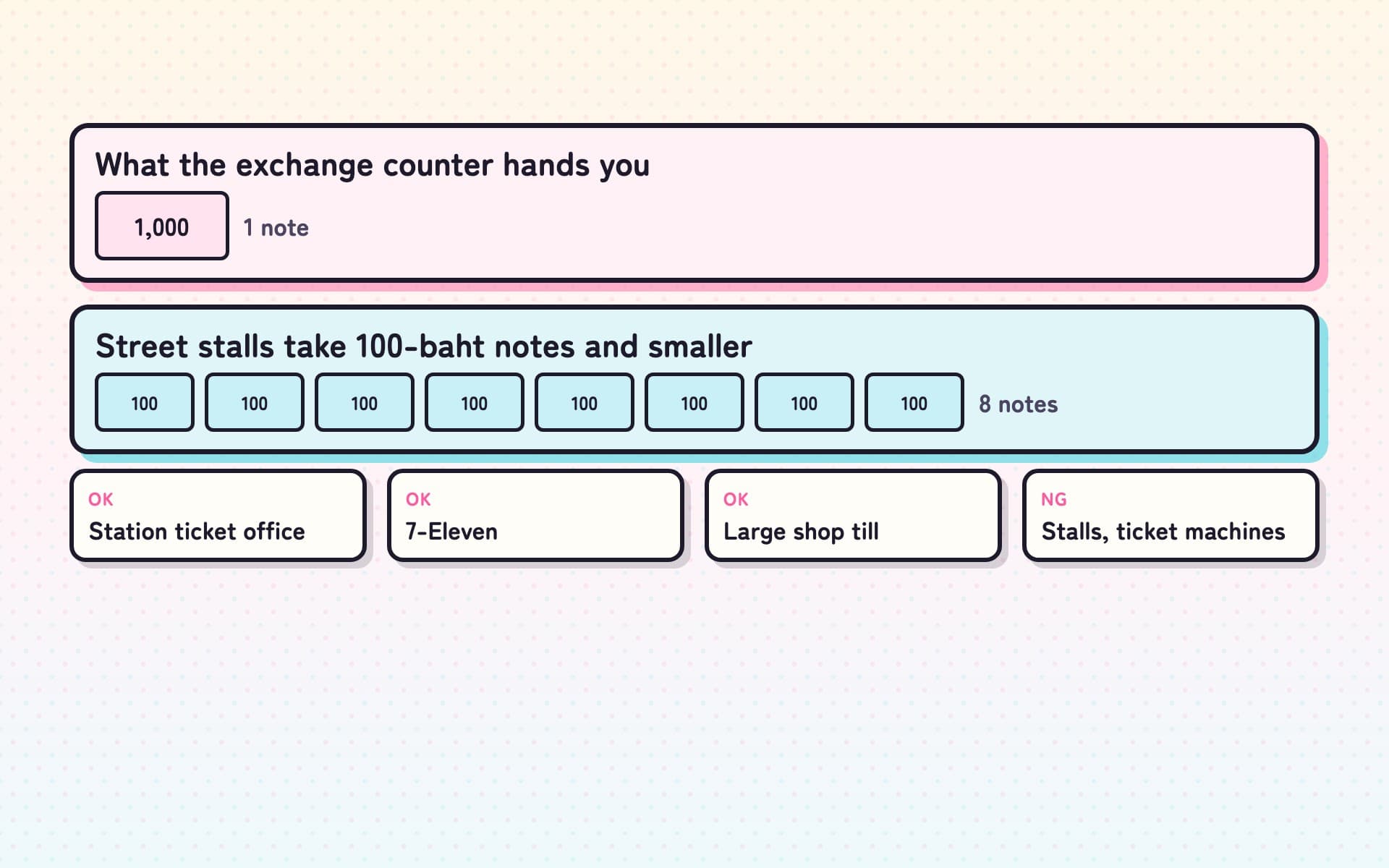
Above is the wallet on leaving the exchange counter, below is the wallet at a street stall. The same number means the same note in both rows: 1 is a 1,000-baht note, 2 is a 500-baht note, 3 is a 100-baht note
01Exchange counters hand over the largest denominations. Street stalls and local eateries usually take nothing above a 100 baht note, so a 1,000 baht note gets turned into 100 baht notes before it is needed.
A street stall's cash drawer does not hold enough small notes to give back against a 1,000-baht note. Even taking a 1,000-baht note, the stall cannot produce the change on the spot. Being turned away is not unkindness; there is simply no change on hand.
3 places break it, and street stalls and small shops are not among them
There are 3 places that will break a 1,000 baht note: a station ticket office, a 7-Eleven, and the till of a large shop. At all 3, handing over a 1,000 baht note as part of paying for something brings the change back in 100 baht notes. Street stalls and small independent shops are not places to break it — they are where the money gets spent afterwards.
Where a 1,000-baht note works, and where it does not
The top row is the 6 places a 1,000-baht note gets handed over, the bottom row is whether it breaks there
02Station ticket machines take notes too, but only up to 500 baht. A 1,000-baht note goes to the ticket office at that same station instead.
1The station ticket office — the 1,000-baht note goes to the window, not the machine
BTS stations have both ticket machines and a ticket office, and a transit card (Rabbit Card) can be topped up at either. On the MRT, the ticket office is the only option on the 2 monorail lines, Yellow and Pink.
Ticket machines, though, take nothing above a 500 baht note, and will not accept a 1,000 baht note. Topping up with a 1,000 baht note means joining the queue at the office rather than the machines.
At a station ticket office I topped up the transit card with 200 baht. I handed over a 1,000-baht note and took back 800 baht in change. The change came as 8 notes of 100 baht, ready to hand over at a street stall.
27-Eleven — load the wallet app, take the change back as 100 baht notes
At a 7-Eleven, cash goes into the wallet app (TrueMoney Wallet). Handing over a 1,000-baht note and loading 200 baht brings back 800 baht in change.
What gets shown at the till is the barcode in the app. Reading out a phone number instead only works for holders of a Thai national ID card.
I handed cash over at a 7-Eleven till myself and loaded the wallet. The balance in the app went up, and the change came back in notes.
3The till of a large shop — which shop to pick for a small purchase
The till of a large shop usually takes a 1,000-baht note. Supermarkets, drugstores and shops inside a mall keep change on hand, so a 1,000-baht note rarely comes back refused there.
Buying a single drink and handing over a 1,000-baht note usually brings the change back in 100-baht notes. That is how the notes in hand turn into 100-baht notes before heading for the street stalls.
Looking at the shop tells which notes work there
Local shops often take nothing above a 100-baht note. Even a 500-baht note comes back refused when there is no change. The kind of shop it is gives a rough idea of the largest note it takes.
| Place of payment | 1,000-baht notes | 100-baht notes | QR code payment |
|---|---|---|---|
| Street stalls and local eateries | Usually not accepted | Accepted | Accepted at many of them |
| Convenience stores | Accepted | Accepted | Accepted |
| Station ticket machines | Does not go in | Goes in | Accepted |
| Shops that take no cash | Not accepted | Not accepted | Accepted |
At a food court with a sign reading "no cash", I held out a credit card and the staff member told me it was PromptPay only. Neither cash nor card would go through, and I was left standing in front of the order counter.
A sign that only says "no cash" does not mean a card will work; some places take nothing but QR.
So the wallet carries both cash and QR.
What a tourist can set up is not the bank's PromptPay
PromptPay links a Thai bank account to a phone number or a national ID. Registering it takes a personal account in Thai baht.
What a tourist without an account gets instead is TrueMoney Wallet, which opens on a passport alone. Payment runs by QR code off the balance loaded into the app.
The wallet opens in the app and fills at a shop
Above is opening it, below is putting cash in
03Opening it takes no trip to a shop. The trip to a shop is for putting cash in, and handing over a 1,000-baht note there breaks it into change.
When I registered this wallet, a passport was the only thing I produced. Verification finished inside the app — a selfie and a photo of the passport, nothing else. The only reason to visit a shop was to put cash in.
I have not used the wallet on the trains yet. Keeping the transit card topped up takes less effort. What to hand over at the gates is covered in the article on the trains in Bangkok.
[Diagram] How to ride trains in Bangkok: BTS or MRT for contactless paymentI stop and look inside my wallet in front of the ticket gate. On Bangkok trains, it is hard to tell on the spot whether to line up for a ticket or just tap a Japanese card. I will look at how to ride the BTS and MRT, starting from how to pay to how to pass through the gates.amiresort.com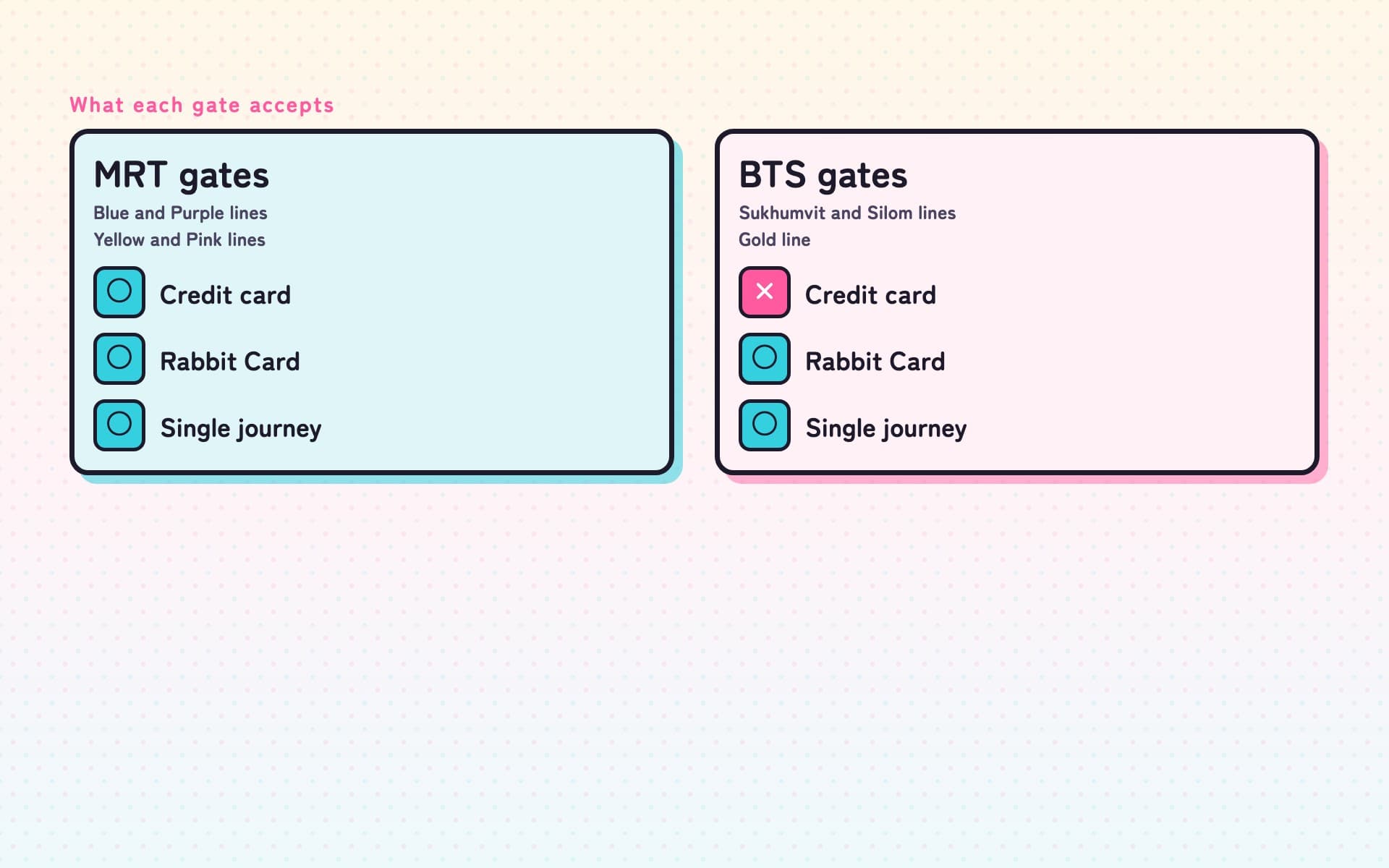
Common misconceptions
- ❌ Thailand runs on cash, so exchanging plenty of it covers everything. In practice, the more that gets exchanged, the thicker the stack of 1,000-baht notes, and what is left in hand is the notes street stalls will not take
- ❌ A 1,000-baht note breaks in a station ticket machine. In practice, the machines take notes up to 500 baht, and a 1,000-baht note goes to the ticket office
- ❌ Transit cards can only be topped up at a ticket office. In fact, on the BTS every station has machines that top up as well. The reason to join the queue at the office is not the top-up — it is the 1,000 baht note
- ❌ Topping up at a 7-Eleven works the same way for everyone. In practice, reading out a phone number at the till only works for holders of a Thai national ID card. Everyone else brings up a barcode in the app for the cashier to scan
- ❌ A visitor can sign up for PromptPay straight away. In fact, registering for it requires a Thai bank account. Without a bank account, cash goes into a wallet app instead, and payments come out of that balance by QR
Splitting the wallet into 4
On the day of arriving in Bangkok, the stop after the exchange counter is a station ticket office or the till of a large shop, where the 1,000-baht notes get broken up front. Before heading for the street stalls, the count of 100-baht notes in the wallet gets a look. When they run low, a single drink breaks another note.
A small balance sits in the wallet as well. In front of a shop that takes nothing but cashless payment, a fistful of notes stops being a dead end.
Breaking a note by topping up at a 7-Eleven works once the wallet is live. On the day of arrival, the note breaks at a station ticket office or the till of a large shop.
Knowing where to break them, a stack of 1,000-baht notes turns into 100-baht notes, coins and QR balance within the day. The exchange counter alone does not finish the preparation for paying in Thailand. The move after the exchange is going out to break them.
| Kept apart in the wallet | Where it comes out |
|---|---|
| 100-baht notes | Street stalls, local eateries, markets |
| 20-baht notes and coins | Paying at a street stall without needing change back |
| 1,000-baht notes | Station ticket offices, convenience stores, registers at large stores. Out only for breaking |
| Wallet balance | Shops that take no cash, and food courts |