 Living and moving — Bangkok trains
[Diagram] How to ride trains in Bangkok: BTS or MRT for contactless payment
I stop and look inside my wallet in front of the ticket gate. On Bangkok trains, it is hard to tell on the spot whether to line up for a ticket or just tap a Japanese card. I will look at how to ride the BTS and MRT, starting from how to pay to how to pass through the gates.
How to ride Bangkok trains starts with how to pay
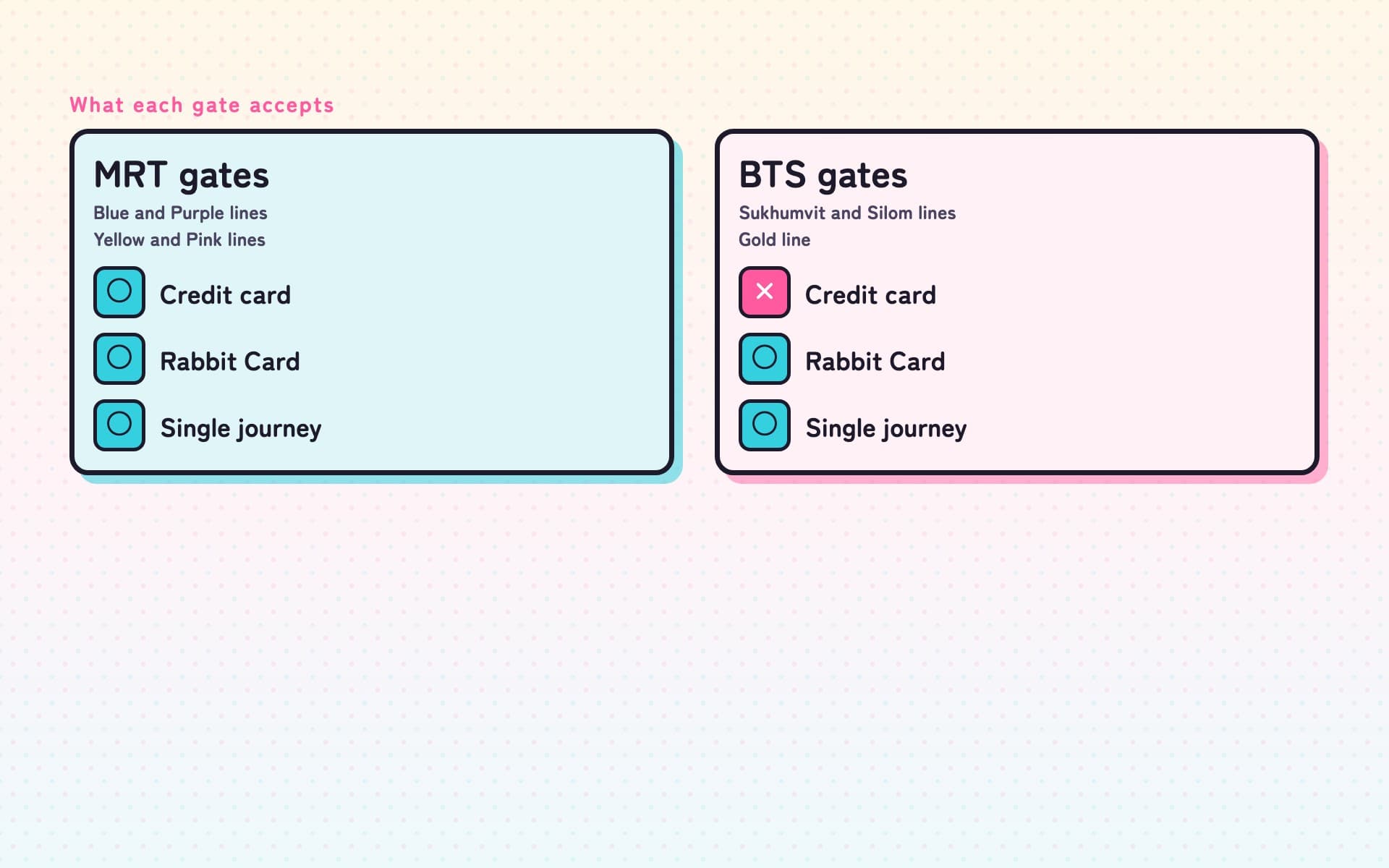
Suppose I have 1 contactless credit card in my wallet that I use in Japan. If it is VISA, Mastercard, or UnionPay, I can pass through the MRT ticket gates just by tapping it on the reader. The BTS ticket gates do not accept the same card, so I line up to buy a ticket.
The ticket gates that can be passed through change depending on what is in hand
The top shows what is in hand, and the bottom shows whether it can pass through the BTS and MRT ticket gates
01Contactless credit card payments work on all MRT lines but cannot be used at BTS ticket gates. The Rabbit Card is accepted on the BTS, as well as the MRT Yellow and Pink Lines. It cannot be used on the MRT Blue and Purple Lines.
There are 4 ways to pay. I choose which one to use
I will look at them in order, from what allows passing without buying anything, to what requires buying first before passing. There are 4 options: a credit card on hand, 1 single journey ticket, a Rabbit Card, and a One-Day Pass, with the latter 3 obtained at the station. Deciding which one to use to pass through in front of the ticket gates determines which line to join.
Standing in front of the ticket machines, people around me are paying with QR codes. I also set up QR payments, but I haven't tried it on the train yet.
| Payment method | BTS (Green, Gold) | MRT (Blue, Purple) | MRT (Yellow, Pink) |
|---|---|---|---|
| Credit card contactless payment | Cannot pass | Can pass | Can pass |
| 1 single journey ticket (Card, Token) | Can pass | Can pass | Needs confirmation |
| Rabbit Card | Can pass | Cannot pass | Can pass |
| One-Day Pass | Can pass | Cannot pass | Needs confirmation |
1Credit card on hand — Only the MRT can be passed through by tapping
The MRT is the only one that can be passed through with a card on hand. With VISA, Mastercard, or UnionPay contactless payment, even a card issued in Japan can be tapped on the ticket gate's reader to pass through. JCB is not accepted even on the MRT, so I buy 1 single journey ticket instead.
When traveling with a companion, 1 ticket per 1 person is required for 1 ride. My companion passes through with a different card or a 1-ride ticket. The Yellow Line and Pink Line do not have automatic ticket gates, and the readers are located next to the manual gates in front of the ticket windows on both sides of the station.
2Single-journey ticket — There are ticket machines that only accept coins
There are 2 types of BTS ticket machines. Machines that only accept coins and machines that can use banknotes and QR codes in addition to coins. The only way to tell which machine it is is by looking at it, so the slot is checked first when taking out banknotes.
I stopped in front of a machine that only accepts coins at Chit Lom. There was no exchange machine, I couldn't find anything to buy to make change, and I didn't feel like lining up again for a ticket machine that accepts banknotes. In the end, I went to the ticket window there and had a Rabbit Card issued.
If only holding coins, a single-journey ticket can be bought at either machine. When the cash on hand is only banknotes of denominations not accepted by the ticket machine, head to the station ticket window. Since the ticket window also handles One Day Passes in addition to single-journey tickets, a ticket can be obtained even if banknotes cannot be inserted into the ticket machine.
3Rabbit Card — How many days of riding the BTS makes it worth getting one at the ticket window
For riding the BTS for many days, a Rabbit Card is made at the station ticket window. What is paid is the issuing fee and the initial balance, and there is no annual fee. It allows heading directly to the ticket gate without lining up to buy a single-journey ticket every time.
The fare is deducted when exiting the arrival station. When I touch the ticket gate, it is automatically deducted from the card balance. When the balance gets low, I add more at the ticket window.
4One Day Pass — For people who ride how many times a day
The one-day pass is a ticket bought at the BTS ticket windows. It is suited for days when riding the BTS multiple times within 1 day. On a day traveling from Siam to On Nut in the east and Bang Wa in the west, I compare the station's fare chart and the price of the one-day pass before deciding.
It can be bought at the station ticket window and is not handled by ticket machines. It is only valid on the day it was bought. If there is a section riding the MRT, that part is paid separately.
BTS and MRT are separate companies. Transfer stations have different names
The operating companies for BTS and MRT are separate. Because of this, transfer stations sometimes have 2 names. Asok on the BTS and Sukhumvit on the MRT are the same place, and Sala Daeng on the BTS and Si Lom on the MRT are also the same place.
Mo Chit in the north also takes the name Chatuchak Park on the MRT. Transferring with the same name happens only a handful of times, like at Bang Wa in the west. Even if they look next to each other on the map, they are searched for with the assumption that the names on the signs are different.
How to pass through the ticket gates changes depending on the payment method
Movements at the ticket gate change between entering and exiting
The top is for entering, and the bottom is for exiting. The same items on hand are assigned the same numbers
02For the MRT token, I touch it to the top of the ticket gate when entering, and drop it into the slot when exiting. Those who enter with a credit card tap the same 1 card to exit. For the Rabbit Card, the fare is deducted when exiting. The MRT Yellow and Pink lines do not have automatic ticket gates, and readers are located next to the manual gates in front of the ticket windows.
Common misconceptions
- ❌ Both BTS and MRT can be passed by tapping a Japanese card. In reality, only the MRT can be passed by tapping, and for the BTS, a single-journey ticket or a Rabbit Card is bought first
- ❌ Having 1 Rabbit Card allows riding both BTS and MRT. In reality, it cannot be used on the MRT Blue and Purple lines, and is usable on the BTS and the MRT Yellow and Pink lines
- ❌ MRT cards can be bought at station windows. In reality, the MRT Card and MRT Plus became unusable on June 1, 2026, and the windows only accept these 2 for refunding the remaining balance
- ❌ 1 card allows a companion to pass through together. In reality, 1 card per person is required for 1 ride, and a companion needs a different card or a single-journey ticket
- ❌ Heard that it became unlimited rides for 20 baht. In reality, it is a flat fare only for those with a 13-digit Thai national ID, and the fare for travelers is determined by distance
What to take out in front of the ticket gates
Riding trains in Bangkok comes down to what is taken out in front of the ticket gates. Those who only ride a few times over a few days pass through with a contactless payment card on hand for the MRT, and a single-journey ticket every time they ride for the BTS.
Those who ride multiple times every day pass through the ticket gates with a Rabbit Card for the BTS, and the same contactless payment card for the MRT. Those without VISA, Mastercard, or UnionPay contactless payments use a single-journey ticket even on the MRT. For the BTS, a single-journey ticket or a Rabbit Card is chosen according to the number of rides.